
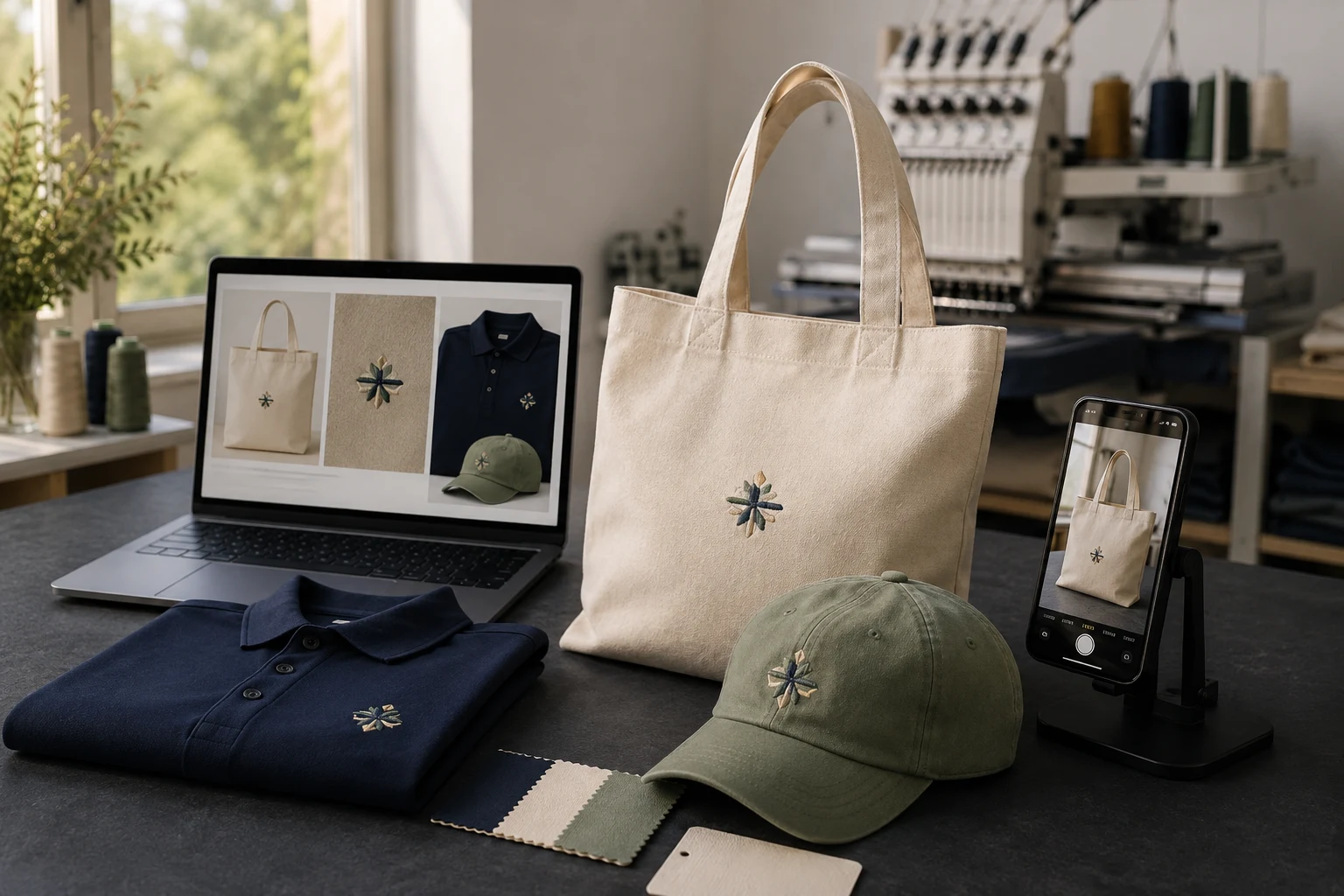
Cover image: AI-generated editorial concept; not a customer project or production proof.
To market an embroidery business, define the buyers you serve, show credible examples of your work, and make requesting a quote straightforward. Use consistent branding across your website, social posts, and emails, then measure which activities lead to suitable inquiries and profitable orders.
A practical starting point is one clear service page, a focused portfolio, and one marketing channel you can maintain. Expand as you learn what customers need and what your production capacity can support.
Understand who you want to reach
Corporate buyers, event organizers, retailers, and individual gift shoppers need different information before ordering. Choose a primary audience for each campaign while keeping your wider service range accessible on your website.
Buyer group | Information to emphasize |
|---|---|
Corporate teams | Garment options, logo placement, approval steps, and repeat ordering |
Event organizers | Required dates, quantities, personalization, and delivery arrangements |
Retailers and boutiques | Product consistency, artwork ownership, packaging, and reorder options |
Individual buyers | Available personalization, size choices, care information, and ordering steps |
Review genuine inquiries to identify recurring questions. If prospects repeatedly ask whether you supply garments or accept customer garments, answer that prominently. Describe an audience or specialty only when your business actually serves it.
For US, Canadian, and UK buyers, specify the currency used in quotes, show dimensions in inches and millimeters where helpful, and distinguish digital file delivery from shipped merchandise. Explain the destinations you serve and how buyers can confirm shipping costs and timing.
Build a recognizable brand with evidence
Your brand includes your name, logo, colors, photography, writing style, and the experience of placing an order. Keep these consistent across your website, quote documents, packaging, and social profiles.
Write a simple positioning statement that identifies your customer, service, and a verifiable reason to choose you. A stated approval process or a clearly presented portfolio is more useful than unsupported claims about being the best.
Create a short brand guide covering:
Approved logo versions and colors.
Fonts and a consistent tone of voice.
Photography backgrounds, lighting, and framing.
How to describe services and ordering stages.
Support quality claims with clear photographs of actual finished work. Include both a close view of the stitching and a wider view showing placement. Identify digital mockups as mockups so buyers can distinguish them from completed embroidery.
Make the customer experience match the presentation. Confirm specifications, record approvals, explain changes, and communicate realistic dates. Obtain permission before displaying customer artwork, photographs, or testimonials.
Make your website answer buying questions
A useful website should help visitors understand what you offer, assess relevant work, and take the next step.
Give each genuinely different service enough space to explain its scope. Clarify whether you provide artwork preparation, embroidery files, finished garments, patches, or a combination. This avoids inquiries based on the wrong expectations.
Include a portfolio organized around buyer needs, such as workwear, event items, or personalized gifts. Add brief factual captions describing the item, placement, and what the image demonstrates.
Use a clear action such as “Request an embroidery quote.” Ask for the information needed to assess the job: artwork, quantity, garment or fabric, placement, desired dimensions, destination, and required date. Explain which details can be confirmed later so the form remains approachable.
For artwork preparation, buyers can review DigitEMB’s embroidery digitizing service. Keep that step clearly distinguished from ordering finished embroidered goods.
Check that visitors can read the page, browse photographs, and complete the form on a phone. Use descriptive image text and understandable form labels. A working confirmation message should explain what happens after submission without promising an unverified response time.
Use search content and local visibility thoughtfully
Write pages around real customer questions. Examples include what to send for a quote, how artwork approval works, and what information is needed for a repeat order.
Use clear page titles, descriptive links, and natural language. Avoid repeating near-identical phrases or creating multiple pages that answer the same question. Google recommends useful, organized content and explicitly discourages keyword stuffing; its guidance does not promise indexing or rankings. See the Google SEO Starter Guide.
Before adding a blog post, compare it with existing pages. Expand an existing answer when the audience and question are the same. Create a separate article when it addresses a distinct buying decision or process in enough depth to justify its own page.
If you meet customers at a physical location or travel to them, check your eligibility for a Google Business Profile. Keep your business name, service area, and contact details accurate. Shipping orders to a city does not establish an office there, and an online-only business should not assume it qualifies. Follow Google’s Business Profile guidelines.
Turn your portfolio into social and educational content
Choose a social platform based on where your actual prospects interact and the material you can consistently produce. Consider Instagram or Pinterest for visual product discovery, Facebook for relevant community conversations, or LinkedIn for corporate relationships. Treat these as options to test against your own inquiries.
A single approved project can support several useful pieces of content:
A finished-item photograph explaining placement and scale.
A short process video showing work in progress.
A comparison between a labeled mockup and the completed item.
A post answering a question that arose during ordering.
Add context instead of posting an unexplained image. Describe the intended use and invite viewers to review the relevant service page or request a quote. Answer comments with practical information, and ask permission before reposting customer content.
Use blog posts, videos, and simple visual explainers to address recurring questions. Publish at a pace that leaves time for production and customer service. A useful answer can remain valuable without a constant stream of trend posts.
Use email to support relevant repeat business
Offer a clear newsletter signup explaining what subscribers will receive. Separate interests where useful: corporate reorders, seasonal retail products, and personalized gifts may warrant different messages.
Send updates with a specific purpose, such as explaining a new option or inviting customers to discuss an upcoming event. Use truthful subject lines, identify the sender, and make opting out straightforward.
Requirements differ by market:
Market | Primary guidance to review |
|---|---|
United States | CAN-SPAM covers commercial email, including business-to-business messages, and requires accurate sender information, a valid postal address, and an opt-out method. See the FTC business guide. |
Canada | CASL generally requires consent, sender identification, and an unsubscribe mechanism. Express and implied consent have different conditions. See the CRTC guidance. |
United Kingdom | PECR generally requires consent or a qualifying soft opt-in for marketing to individual subscribers; corporate subscriber rules differ. See the ICO electronic mail guidance. |
Keep records of signup permissions and preferences. Do not assume that receiving an inquiry automatically permits an ongoing marketing sequence.
Test paid advertising with a clear goal
Before paying for traffic, confirm that your landing page explains the advertised service and that its inquiry form works.
Start with one audience, one offer, and a spending limit you can afford. Match the advertisement to the destination page: an ad about embroidered workwear should lead to relevant workwear information.
Define a qualified inquiry before evaluating results. It might require a service you provide, a workable quantity, and a feasible required date. Review lead quality alongside clicks and advertising costs. If clicks produce unsuitable requests, adjust the message or audience before increasing spending.
Measure inquiries and orders alongside attention
Website visits, followers, and post interactions provide context, but they do not establish whether marketing is producing worthwhile work. Track where inquiries originate and what happens after the first contact.
Measure | How to use it |
|---|---|
Website visits and page views | Identify which pages attract attention; compare with inquiry activity. |
Qualified inquiries | Count requests that fit your services and capacity. |
Quote acceptance | Divide accepted quotes by quotes issued for a consistent group or period. |
Cost per qualified inquiry | Divide campaign spending by qualified inquiries attributed to it. |
Repeat orders | Track returning buyers and the services they reorder. |
Social and email responses | Review useful comments, clicks, replies, and unsubscribes alongside resulting inquiries. |
Use consistent definitions when comparing periods. Record the source of an inquiry in your order notes and ask buyers how they found you when attribution is unclear.
In Google Analytics 4, bounce rate means the percentage of sessions that were not engaged. It is not simply the percentage of visitors who viewed one page. Google defines an engaged session as lasting longer than 10 seconds, containing a key event, or having at least two page or screen views. See Google’s engagement and bounce-rate definitions.
When reviewing returns, account for production costs and the time spent creating content or handling inquiries. Revenue alone does not show marketing profitability.
Keep the plan manageable
For a small team, a suggested first month is to clarify positioning and quote requirements, improve a key service page, assemble a focused portfolio, and test a small sequence of posts or permitted emails.
Review results before adding another channel. If inquiries stall at quoting, improve the information and follow-up process. If prospects cannot understand the service, revise the page. Follow official platform updates when they affect tools you use, without rebuilding your strategy around every trend.
Frequently asked questions
What should an embroidery business market first?
Start with a service you can deliver consistently and a buyer group whose requirements you understand. Create a relevant portfolio and a clear quote path before expanding campaigns.
Is social media enough without a website?
Social profiles can start conversations. A website gives buyers a central place to review service details, examples, ordering information, and contact options. Keep both consistent.
How much should a small embroidery business spend on marketing?
There is no universal amount. Set a limit based on available cash, order margins, and production capacity. Include your own time, then compare spending with qualified inquiries and accepted orders.
How can I distinguish my brand without competing on price?
Show relevant finished work, explain your process, and make approvals and reorders easy to understand. Use specific, verifiable strengths instead of generic quality claims.
Practical details for Digital Marketing and Branding for Embroidery Businesses
The best next step is to translate the topic in this article into a short, specific brief. That gives everyone involved the same reference before a file, proof or finished product is prepared.
Work through these points in order and keep the answers with the artwork or production request. A short written brief makes it easier to compare a proof with the intended result, ask a useful follow-up question and avoid relying on assumptions made from a screen image alone.
The aim is not to add unnecessary steps. It is to identify the choices that change the final result before work begins. If a requirement is unknown, flag it for confirmation rather than guessing; that keeps the approval process focused on the design, material and use that apply to this particular project. Save the approved brief with the project files for future reorders or revisions.
State the intended outcome
Describe where and how the finished item will be used, who it is for and the result that matters most. This helps separate a useful requirement from a visual preference.
Collect the source material
Provide the clearest artwork, references and text available. Mark anything that cannot change, such as a logo, spelling, colour or placement requirement.
Review the final details
Before approving work, check the real size, material, format and any production constraints. Confirm the details that affect how the design will look in use, not only on a screen.
Quick questions to check before you proceed
What should I prepare first?
Start with the artwork, its intended use, finished size and any requirements that cannot change.
Why is a proof important?
A proof is the shared reference for checking details before production. It is the best time to correct a size, spelling, colour or placement issue.
What makes a useful request?
A clear request explains the goal, provides the best available source material and identifies the details that need approval.