
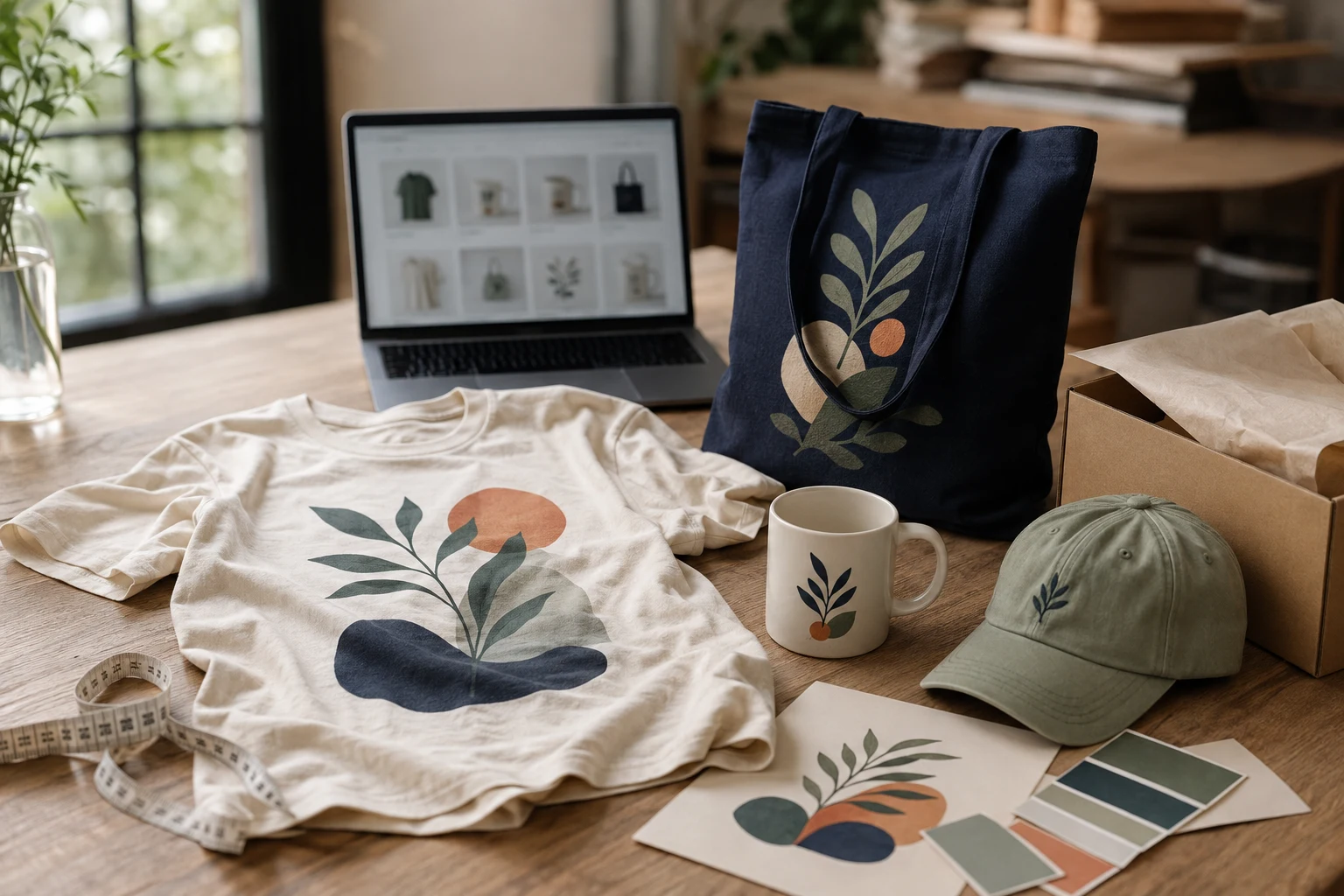
Cover image: AI-generated editorial concept; not a customer project or production proof.
The most useful print-on-demand business tips are to choose a clear audience, test physical samples, price for the full cost of each order and give customers accurate product information. Start with a manageable collection, learn from actual orders and expand when quality and fulfillment are dependable.
Print on demand means products are made after an order is placed. It can reduce the need to buy finished inventory upfront, but artwork, samples, marketing and customer support still require time and money. These 15 tips cover the journey from choosing a brand name to building lasting customer relationships, including practical considerations for serving buyers in the US, Canada and the UK.
1. Choose a clear, memorable brand name
Write down words that reflect your audience, products and style. Shortlist names that are easy to pronounce, spell and recognize on a small product label. Avoid a name so specific that it becomes awkward if you later add related products.
Check domain names and social handles, then investigate similar business names and trademarks. An available domain alone does not establish that a name is safe to use. The USPTO explains that trademark clearance involves more than searching for an exact match: similar names and related goods also matter. See its federal trademark searching guidance.
2. Pick a niche you can understand and test
Define who would buy the product, what they would use it for and why the design would appeal to them. “Gifts for people who enjoy gardening” gives you more direction than “shirts for everyone.” Combining interests can help, provided the combination makes sense to buyers.
Use conversations with potential customers, public product reviews and small collection tests to refine the idea. Look for specific preferences: subtle artwork, inclusive sizing, practical gifts or designs suited to a particular occasion.
Treat likes and compliments as early feedback. Purchases, repeat interest and useful product questions provide stronger evidence that an idea deserves more investment.
3. Match the artwork to the product and production method
A design that works on a flat poster may need a different layout on a curved mug, small cap or garment chest. Check the decoration area, placement, material and available production method before finalizing the artwork.
Download the supplier’s template for the exact product. Review file format, pixel dimensions, resolution at the intended print size, color profile and any safe-area or bleed requirements. Avoid applying one export setting to every supplier and product.
For example, Printful recommends checking product-specific guidelines and using its specified sRGB profile; PNG and JPEG suitability depends on the design and printing method. These are provider instructions, not universal specifications. See Printful’s print-file preparation guidance.
If you add embroidery, ask the fulfillment provider whether it accepts externally digitized files before commissioning one. You can review DigitEMB’s embroidery digitizing services when a separate digitizing service fits the provider’s workflow. Confirm the required format, finished size and garment details first.
4. Build a focused marketing plan
Choose a clear message and a manageable way to reach your audience. Show the product in use, explain the design and answer the questions that might prevent a purchase.
Possible approaches include product demonstrations on social media, useful articles, creator collaborations, local events and email updates for subscribers. Start with channels you can maintain consistently instead of launching every option at once.
For each campaign, decide what you want visitors to do and how you will measure it. Track visits, purchases and the cost of acquiring an order. A popular post is useful only if it supports your business goals.
5. Make product listings easy to find and understand
Use descriptive titles and natural language that matches the product. Include relevant details such as garment type, design theme, material, fit and intended use. Give customers a reason to choose the item through accurate information and original photography.
Write useful descriptions rather than repeating search phrases. Add descriptive alternative text to informative images and make your store easy to navigate. Google’s SEO Starter Guide emphasizes helpful, organized content and explains that SEO offers no automatic ranking guarantee.
For marketplace listings, consult that marketplace’s current guidance. Search features and listing fields differ between platforms.
6. Price using the full cost of an order
Compare your selling price with everything you pay to complete and support a sale. Include more than the supplier’s base product charge.
Cost category | What to include |
|---|---|
Production | Blank product, decoration and additional placements |
Delivery | Supplier shipping, packaging extras and shipping you subsidize |
Selling fees | Marketplace, payment-processing and applicable currency-conversion fees |
Customer acquisition | Advertising or other spending attributable to winning orders |
Problem allowance | Expected replacements, refunds and support costs |
Business overhead | Samples, artwork, subscriptions and your working time |
Calculate the contribution from each order by subtracting its variable costs from net sales revenue. That contribution must help cover overhead and leave room for profit.
Check the calculation separately for domestic and cross-border orders. Before running a discount or offering free shipping, recalculate the result. Do not assume a bulk order costs less per item unless your supplier confirms it.
7. Study competitors without copying them
Compare products that serve the same audience and buying occasion. Look at design style, product specifications, photography, delivery information and recurring complaints in public reviews.
Use this research to identify a useful difference: clearer sizing, a more coherent collection or better product explanations. Low competition may indicate an opportunity, but it can also indicate limited demand.
Avoid competing only on the lowest listed price. Check whether competing offers include equivalent materials, decoration and delivery before drawing conclusions.
8. Keep color options intentional
Choose product colors that give the artwork enough contrast and suit your audience. Inspect every offered combination; a design may become hard to read when placed on a different background.
There is no universal five-color limit. A small initial selection can simplify photography and quality checks, but the right number depends on the product and what customers want.
Expand colors when requests and order data justify the extra work. Remove combinations that create avoidable quality or availability problems.
9. Expand the product range gradually
T-shirts are only one option. A collection might include tote bags, mugs, caps, cushions or posters, depending on the supplier and audience.
Add products because they serve a real use, rather than placing the same artwork on everything available. Redesign the layout when the surface or viewing distance changes.
Order a physical sample before listing a new product. Examine placement, color, material, construction and packaging. For washable items, evaluate the sample using the supplier’s care instructions. Keep notes so you can compare future samples or replacement products consistently.
Also review fulfillment arrangements for each destination. Confirm product availability, production estimates, shipping options, tracking and how defects are handled before accepting orders.
10. Confirm your rights to names, artwork and fonts
Use original artwork or obtain permission that covers your intended merchandise use. Check licenses for purchased graphics, fonts and design elements, including restrictions on print-on-demand products, quantities and modifications. Keep the relevant license and purchase records.
Finding an image online does not make it available for commercial use. The U.S. Copyright Office explains permission and licensing in its guide to obtaining permission.
Check relevant trademark resources for the markets you plan to serve: the USPTO, Canadian Trademarks Database and UK trade mark search. Database searches are a starting point, not a guarantee of clearance.
Do not assume that changing a font, redrawing a logo or rewording a slogan removes a rights issue. Resolve uncertain rights before offering the design for sale.
11. Use photography that sets accurate expectations
Photograph actual samples in even light. Include an overall view, a close-up of the decoration and an image that helps buyers judge scale or fit.
Mockups can help present a collection, but compare them with the physical product. Check that artwork size, position and available colors are represented accurately. Avoid editing that makes the print, fabric or finish appear different from the sample.
Provide the exact product’s size chart and explain how measurements are taken. Showing dimensions in both inches and centimeters makes listings easier to use across the US, Canada and the UK.
12. Make promotions truthful and specific
Use a limited-time offer only when there is a real end date. Describe an item as a limited edition only when you have set and will honor an actual limit.
Avoid stock warnings that imply finished inventory is running out when that is not how the product is supplied. If a blank product becomes unavailable, communicate that specific issue.
Seasonal collections and genuine ordering deadlines can give customers a useful reason to act. Base any arrival messaging on current supplier and carrier information, and distinguish estimates from guarantees.
13. Add sales channels when operations are ready
Begin with a channel you can manage reliably. Before adding another marketplace or independent store, make sure product variants, order routing, customer messages and refunds are working consistently.
Review each channel’s current rules, fees and production-partner requirements. Test the complete order process, including personalization details and shipping addresses, before directing customers there.
Additional channels create more ways to reach buyers, but they also create more listings and support work. Assess each channel on its contribution after costs and the time it requires.
14. Ask for feedback you can act on
Friends and family can spot confusing descriptions, but target customers are better placed to judge whether a product meets their needs.
Ask specific questions: Was the fit clear before ordering? Did the decoration match the photos? Was the packaging suitable? Which information was missing?
Record recurring issues by product and variant. If several buyers mention the same problem, investigate the listing, artwork or supplier rather than treating each complaint as unrelated. Use feedback to improve the next order and request honest reviews without directing customers toward a positive rating.
15. Make customer service part of the product
Explain production time separately from shipping time. State the currency clearly, provide delivery information for the destination and explain how buyers can report a damaged or incorrect item.
For US, Canadian and UK customers, make return instructions, contact details and any known cross-border charges easy to find before checkout. Confirm destination-specific arrangements with your supplier instead of reusing one domestic policy everywhere.
Your supplier’s reimbursement policy and your obligations to customers are separate matters. For example, UK guidance distinguishes cancellation exceptions for personalized or custom-made items from rights relating to faulty goods. Avoid assuming every POD item qualifies for an exception simply because it is produced after ordering. See GOV.UK’s returns and refunds guidance.
When something goes wrong, acknowledge the issue, explain the next step and keep the buyer updated. Apply what you learn to product information and future orders.
Frequently asked questions
What should I do first when starting a print-on-demand business?
Choose a specific audience and a small product collection. Confirm artwork rights, order samples and calculate order costs before investing heavily in promotion.
Do I need a vector file for every POD product?
No. Follow the exact product’s requirements. Some workflows accept raster files such as PNG or JPEG. A vector master can be useful for editing, but your supplier may require a different upload format.
How many products and colors should I launch with?
Start with a range you can sample, photograph and support properly. There is no fixed number that fits every store. Expand when customer demand and dependable fulfillment justify it.
Can I use one supplier for customers in the US, Canada and the UK?
Possibly, but check each product and destination. Compare availability, production location, delivery estimates, shipping costs and return arrangements before enabling a market.
Should I offer free shipping?
Only when your pricing supports it. Include the shipping expense in your order calculation and check different destinations and basket sizes before making the offer.
Practical details for 15 Practical Tips for Building a Print-on-Demand Business
The best next step is to translate the topic in this article into a short, specific brief. That gives everyone involved the same reference before a file, proof or finished product is prepared.
Work through these points in order and keep the answers with the artwork or production request. A short written brief makes it easier to compare a proof with the intended result, ask a useful follow-up question and avoid relying on assumptions made from a screen image alone.
The aim is not to add unnecessary steps. It is to identify the choices that change the final result before work begins. If a requirement is unknown, flag it for confirmation rather than guessing; that keeps the approval process focused on the design, material and use that apply to this particular project. Save the approved brief with the project files for future reorders or revisions.
State the intended outcome
Describe where and how the finished item will be used, who it is for and the result that matters most. This helps separate a useful requirement from a visual preference.
Collect the source material
Provide the clearest artwork, references and text available. Mark anything that cannot change, such as a logo, spelling, colour or placement requirement.
Review the final details
Before approving work, check the real size, material, format and any production constraints. Confirm the details that affect how the design will look in use, not only on a screen.
Quick questions to check before you proceed
What should I prepare first?
Start with the artwork, its intended use, finished size and any requirements that cannot change.
Why is a proof important?
A proof is the shared reference for checking details before production. It is the best time to correct a size, spelling, colour or placement issue.
What makes a useful request?
A clear request explains the goal, provides the best available source material and identifies the details that need approval.