
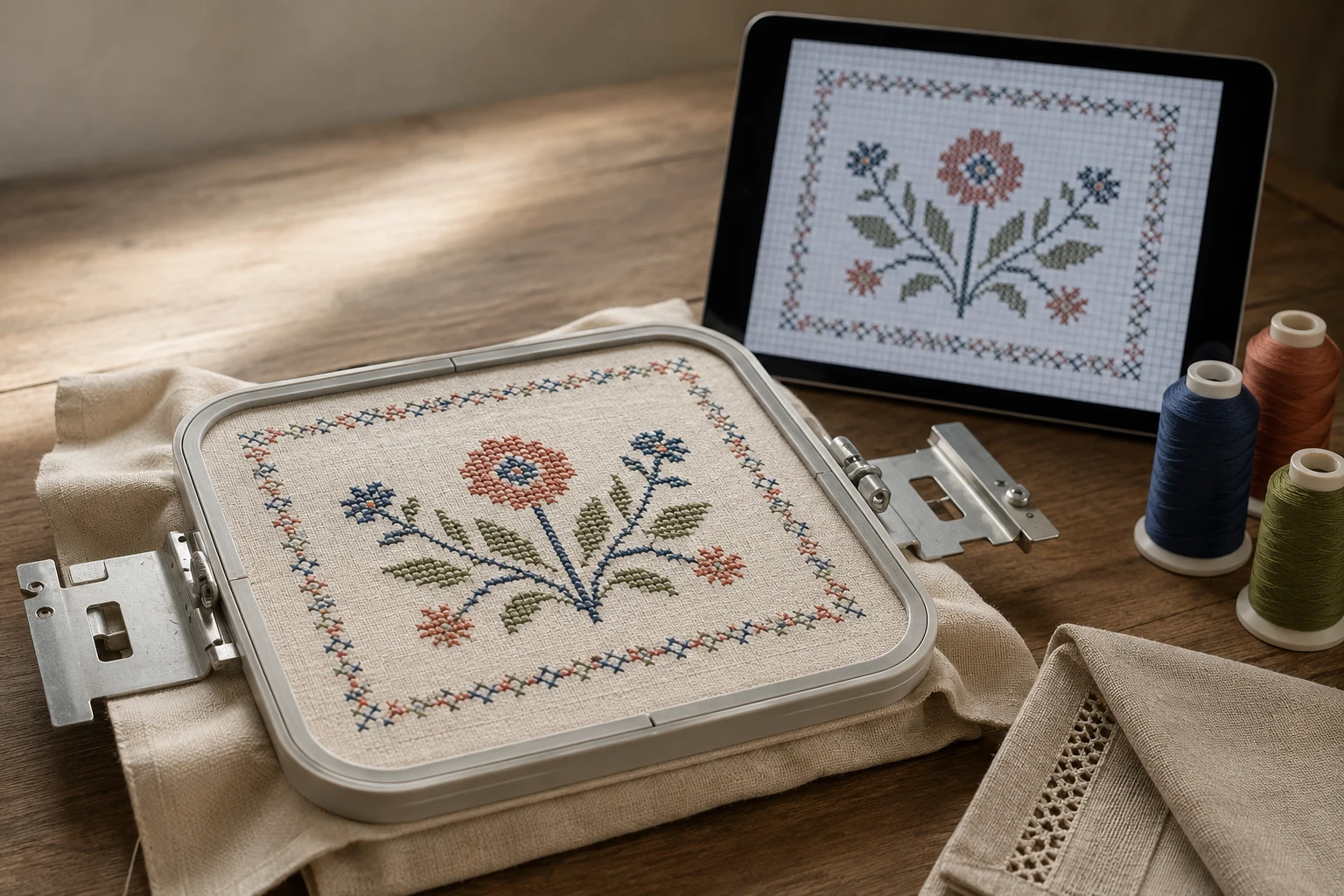
Cover image: AI-generated editorial concept; not a customer project or production proof.
To digitize a cross stitch pattern for machine embroidery, set the finished size and cross stitch grid, assign colors, create the outlines and fills, then adjust fractional stitches and density. Generate the stitches, prepare a compatible machine file and test the design on the intended fabric before production.
Cross stitch can add a geometric texture to table linens, home accessories, children’s clothing and folk-inspired designs, including projects combined with appliqué. The workflow below preserves that range while explaining the individual tools. These applications are described in Wilcom’s cross stitch overview.
Set up the pattern and finished size
The software steps here follow Wilcom EmbroideryStudio e4’s ES Cross Stitch documentation. Confirm that your installation includes the cross stitch option; other versions and applications may use different controls.
Start with clear artwork or a readable chart, the intended fabric, the placement and the required finished dimensions. For a first exercise, use a simple motif with a solid center, a curved edge and a contrasting border so you can practice several tools in one design.
Traditional counted cross stitch follows the fabric’s evenly spaced structure. In machine digitizing, the software grid determines cross placement, and its fabric count setting does not necessarily match the fabric’s actual weave. In ES Cross Stitch, open Special > Fabric Count to set the scale. Increasing crosses per inch makes the same grid pattern smaller. See Wilcom’s design sizing instructions.
For a pattern measured in grid cells:
Width in inches = number of cells across ÷ crosses per inch.
For example, 40 cells at 10 crosses per inch span 4 inches, or 101.6 mm. This is a sizing example, not a recommended density for every fabric. Specify both width and height, with units, when sharing a project between US, Canadian and UK teams.
Digitize individual stitches and lines
The Pencil tool is useful for isolated details, short borders and corrections to a larger pattern.
Choose Single Line for a line or Full Cross for a row of crosses. With Full Cross selected, the active cross stitch style determines the result.
Choose the thread color from the palette.
Activate Pencil.
Click a grid cell to place an individual stitch, or drag across cells to draw a line.
In the documented e4 workflow, hold Ctrl while dragging to constrain a straight vertical line.
You can also use Pencil to combine differently colored partial crosses within a cell. Inspect the result closely so each partial stitch occupies the intended position. These controls are documented in Wilcom’s single-stitch and line guide.
Create circles and ovals
Use Input > Circle to build a round motif or an oval border:
Activate Circle and choose a color.
Select an outline or fill stitch type for the shape.
Click to establish its center, then click a point on its circumference.
Press Enter to complete a circle, or place a third reference point to define an ellipse.
The selected stitch type determines whether the result is outlined or filled. Follow Wilcom’s Circle tool instructions.
Review the shape at its intended size. Judge whether the stepped cross stitch edge suits the motif before spending time on small decorative details.
Choose outlines, fills and fractional stitches
Outline and fill describe two roles within this cross stitch workflow. Choose them separately according to the appearance you need.
Design element | Practical choice |
|---|---|
Fine outline or small linear detail | Single Line |
Border made from repeated crosses | Full Cross outline, using the active cross stitch style |
Main filled area | Begin with full crosses and assess the texture |
Curved edge or divided color cell | Consider quarter or three-quarter crosses |
Small accent | Consider mini crosses or a decorative stitch style |
Select a palette color before drawing. For fills and cross borders, select the stitch style from the Stitch toolbar. To recolor an existing area, select its stitch block and apply the new color. See Wilcom’s color and stitch type controls.
Available decorative options include upright crosses, double crosses, elongated horizontal and vertical crosses, and French knots. Use them where their texture helps the design. Quarter and three-quarter stitches can refine rounded edges; mini crosses occupy a quarter of a grid cell. Wilcom illustrates these options in its Cross Stitch Supplement.
Draw a filled shape and set its direction
Activate Cross Stitch Fill, select the color and stitch type, then place points around the shape. In this workflow, left-click for sharp corners and right-click for rounded corners. Press Enter to finish the boundary.
For stitch types requiring orientation, the Select Fill Style dialog lets you choose the occupied corner or side:
For a three-quarter cross, select the corner containing its quarter-stitch portion.
For a half or quarter cross, select the intended starting corner.
For a mini cross, select the corner where it belongs.
For an elongated vertical cross, select the side it should occupy.
Confirm the choice and inspect the filled area. Direction matters particularly where neighboring colors share a cell or fractional stitches define an edge. See Wilcom’s fill and orientation instructions.
Adjust density and inspect the sew-out
Cross stitch is not automatically a low-stitch-count choice. Grid size, filled area and repeated stitching all affect the result.
In ES Cross Stitch e4, the Threads values 2, 4 and 6 represent single, double and triple stitching respectively. They control repeated stitching in the software; they are not instructions to thread several strands through the machine needle. Wilcom identifies pulling and gaps as possible problems with small, closely packed crosses in its density guidance.
Use a sample on the intended fabric and stabilizer to decide whether the crosses remain distinct and the material lies flat. Inspect the front and back for distorted outlines, crowded intersections, gaps and unwanted connecting threads. Change one setting at a time so you can identify what improved the result.
If the design must become smaller, revisit cross size and repeat settings. Wilcom warns that resizing to fit a hoop can stack stitches and pull the fabric; see its hoop and resizing guidance.
Generate stitches and prepare the machine file
A grid preview needs to become actual embroidery stitches. In ES Cross Stitch e4, choose Stitch > Generate. This generates the stitches and saves an EMX file, prompting for a name when necessary. See Wilcom’s Generate instructions.
Save and close the cross stitch design, then open its EMX file in EmbroideryStudio for further embroidery work. Imported EMX content is treated as manual stitch blocks, so Wilcom advises against scaling it there. Make size decisions earlier in the cross stitch workflow. See using cross stitch with EmbroideryStudio.
Prepare the final file in a format supported by the receiving machine. A machine file contains stitch coordinates and machine functions; changing an image’s filename extension does not create those instructions. Wilcom explains this distinction in its embroidery file glossary.
When requesting help through DigitEMB’s embroidery digitizing service, provide the artwork or chart, finished dimensions, fabric, placement, machine model, required file format and color references. Specify that you want a visible cross stitch texture, and ask whether the proposed design can retain its detail at your chosen size. Agree on who will perform the physical sew-out before approving production.
Frequently asked questions
Can I use a hand cross stitch chart for machine embroidery?
Yes, as a reference for grid positions and colors. It still needs machine stitch generation and a compatible output file. Review fractional stitches and the finished dimensions rather than assuming the hand chart’s fabric count will transfer unchanged.
Why does my cross stitch design look too dense?
Check cross size and repeat settings first. Small crosses combined with repeated stitching can create crowded intersections and pulling. Compare a revised sample before applying the change to the full project.
Can I combine cross stitch with appliqué or other embroidery?
Yes. Cross stitch can form part of a mixed-technique design, and an EMX design can be opened in EmbroideryStudio for additional embroidery. Plan the combined layout at its final size and sample the complete design, including its borders and transitions.
Practical details for How to Digitize Cross Stitch Patterns for Machine Embroidery
Use the article above as a starting point, then make the production brief specific to your own design. A stitch file is made for a finished size and material, so the artwork alone is only part of the instruction.
Work through these points in order and keep the answers with the artwork or production request. A short written brief makes it easier to compare a proof with the intended result, ask a useful follow-up question and avoid relying on assumptions made from a screen image alone.
The aim is not to add unnecessary steps. It is to identify the choices that change the final result before work begins. If a requirement is unknown, flag it for confirmation rather than guessing; that keeps the approval process focused on the design, material and use that apply to this particular project. Save the approved brief with the project files for future reorders or revisions.
Confirm the finished use
State the item, placement and finished width and height. A chest logo, cap front and jacket back do not use the same sewing area, even when they start from the same artwork.
Protect the smallest details
Review small lettering, narrow gaps, thin outlines and tiny colour changes at the final size. Simplifying a fragile detail before digitizing is often more reliable than trying to force it into a small sew-out.
Match the file to the machine
Tell the production team the embroidery machine or format required, along with the fabric or garment type. This lets them prepare the right export and make choices that suit the material rather than treating every job alike.
Quick questions to check before you proceed
What should I send with my artwork?
Send the clearest original available, the finished dimensions, placement, fabric or garment type and the required machine format if you know it.
Can the same file be used at every size?
Not always. Scaling changes the relationship between stitch length, detail and fabric, so a design may need review when the finished size or placement changes.
What should I check before production?
Confirm the spelling, colours, final size, placement and any details that must remain readable. A proof or sample is the best point to catch a change.